


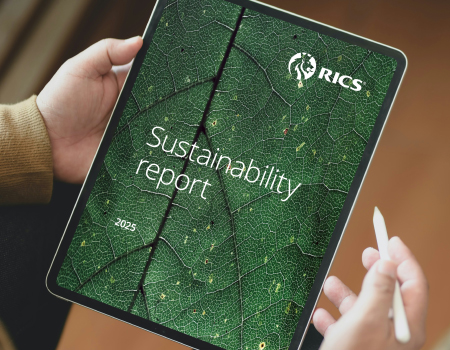

The built environment sits at the heart of the climate challenge, and the opportunity. Responsible for almost 40% of global carbon emissions, our sector has long been recognised as a critical lever in the transition to a low-carbon future. Yet the latest RICS 2025 Sustainability Report reveals a troubling shift: momentum behind sustainable buildings is slowing, while progress on carbon measurement in construction remains inadequate.
For an industry that has spent the past decade championing net zero, this should be a wake-up call.
Demand for sustainable buildings is softening
RICS’ Sustainable Building Index shows that while demand for green buildings remains positive, growth has slowed across most global regions over the past year. The index now sits at a net balance of +30, down from stronger readings in previous years.
The slowdown is most pronounced in the Americas, but it is also evident across the UK, Europe and Asia Pacific, with only the MiddleEast and Africa showing stronger momentum. This cooling of demand appears to be driven by economic uncertainty, shifting policy priorities and lingering concerns around cost and return on investment.
This highlights a risk that sustainability is still being treated as a “nice to have” - something that can be deprioritised when conditions become more challenging. In reality, this is simply not the case.
Certification alone is not enough
The report shows that investors continue to place significant value on green building certifications, with 86% identifying certification as a key feature of a sustainable asset.
While accreditation plays an important role in setting benchmarks and improving transparency, RICS rightly cautions that certification alone does not always reflect true whole-life performance.
From an M&E and building services perspective, this is a critical point. Operational energy use, system efficiency, resilience and whole-life carbon performance are driven by design decisions made early in a project. Without robust engineering input and performance-led design, there is a real danger that sustainability becomes more about compliance than impact.
Carbon measurement remains the industry’s blind spot
Perhaps the most concerning finding in the report is the lack of progress in carbon measurement.
Around 46% of construction professionals globally do not measure carbon emissions on their projects, a figure that has actually increased over the past year. And only 16% of respondents say they measure carbon in a way that significantly influences material and system choices.
This is a fundamental issue, because if carbon is not being measured, it cannot be managed, and opportunities to reduce embodied and operational emissions are routinely missed.
For an industry serious about net zero, whole-life carbon assessment should be standard practice: a fundamental part of project decision-making, not a specialist add-on.
Skills, standards and leadership are key
RICS’ findings reinforce what many in the industry already know: ongoing skills gaps, lack of standardised approaches and inconsistent client demand are holding us back. But none of these challenges are insurmountable.
Policy and regulation are beginning to push the industry in the right direction, but the report makes clear that their impact is still largely seen as “modest”, with fewer than 20% of respondents believing regulation is having a high impact in their region. Stronger, more consistent requirements for carbon measurement and reporting will be essential, but regulation alone will not deliver better buildings.
Mandatory whole-life carbon reporting, aligned to recognised standards such as RICS’ Whole Life Carbon Assessment for the Built Environment, is an essential next step. But regulation must be matched by leadership within the supply chain.
Real change comes when clients, designers and engineers work together to prioritise the long-term value of genuinely low-carbon buildings. Realising value not just in environmental terms, but in resilience, adaptability and operational cost certainty.
Turning a slowdown into a turning point
The slowdown in sustainable building demand is not areason to step back from sustainability. It is a clear signal that we need todo it better.
High-quality building services design has a critical role to play. Optimised energy systems, electrification strategies, fabric-first thinking and early-stage carbon modelling are no longer “best practice” but business essentials.
At Green Building Design, we believe the next phase of sustainable construction must be driven by measurable outcomes, not just good intentions. That means embedding whole-life carbon thinking from the earliest stages of design, using data to inform decisions, and ensuring building services are engineered to perform, not just to comply. As M&E engineers and low-carbon consultants, we help clients navigate complexity, manage risk and unlock genuine long-term value from sustainable buildings.
If demand is slowing, the response should not be to dilute ambition, but to sharpen it. Now is the time to move beyond labels and targets, and focus on buildings that demonstrably use less energy, emit less carbon and perform better for the people who occupy them.
The message from RICS is unambiguous. The tools, standards and knowledge exist. What is needed now is consistent application, stronger leadership and a renewed focus on measurable outcomes. That is where meaningful progress will be made, and where we at Green Building Design continue to focus our expertise.
For more information on how Green Building Design can support your project with low-carbon building services design, contact us today.



.png)


